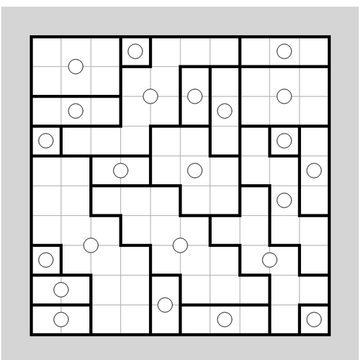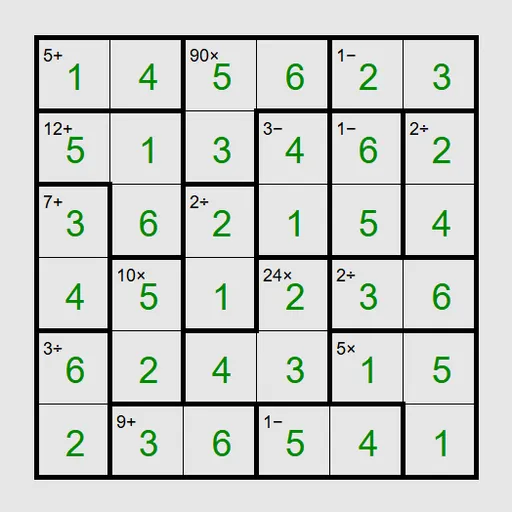
Math Cage Grid combines a no-repeat number grid with quick mental arithmetic. Bold lines divide the board into cages, and each cage shows a target and an operation, such as 7+ or 12x. You fill every square so each cage reaches its target and no row or column has a repeated digit.
How Math Cage Grid Works
On a board of size n, every row and every column holds each digit from 1 to n exactly once. So a 6x6 board uses 1 to 6 in each line.
Cage clues add more limits. A plus cage must add up to its number, and a times cage must multiply to it. Minus and divide clues only appear on two-square cages, and the digits can go in either order. A cage with only one square just gives you that digit.
Click or tap a square and enter a digit, or add pencil marks for the candidates you are still weighing. Presets go from 4x4 Easy up to a 9x9 board, across five difficulty levels. Custom games let you choose any size from 3 to 9 and switch on a multiplication-only mode.
Your First Few Minutes
- Choose a small preset such as 4x4 Easy from the menu.
- Fill in every one-square cage, since those digits are given.
- Pick a two-square cage and list which digit pairs could reach its target.
- Cross-check those pairs against the digits already in the same row and column.
- Use pencil marks for squares with two or three choices, and narrow them as other squares fill in.
Controls for Math Cage Grid
| To do this | Keyboard | Mouse | Touch screen |
|---|---|---|---|
| Enter a digit | Arrow keys to move, then type the digit | Click a square, then type a digit | Tap a square, then tap a digit button |
| Add or remove a pencil mark | Enter switches the cursor to pencil mode, then type a digit | Right-click a square, then type a digit | Set Tap to Pencil mark (or press and hold a square), then tap a digit |
| Clear a square | Space, Backspace or 0 | not used | Tap the square, then Clear |
| Fill every empty square with all pencil marks | M | not used | not used |
| New game, undo, redo | N, U, R | Menu buttons above the grid | Menu buttons above the grid |
What It Trains
This puzzle exercises math constantly. You break 12x into factor pairs, split sums into possible digits and use differences to rule things out, all with small numbers you work out in your head.
It is just as much a logic game. Every digit you place removes options elsewhere in its row and column, so you chain small deductions together until the board resolves.
Strategy Notes
- Take the free squares. One-square cages are given digits, so place them first.
- Use extreme cages. On 6x6, 11+ in two squares must be 5 and 6, 3+ must be 1 and 2, and a 5- cage can only be 1 and 6.
- Factor large products. A product with a factor of 5 needs a 5 inside the cage on boards of this size.
- Use the row total. Each 6x6 row adds to 21, so if whole cages cover a row except one square, subtract to get it.
- Fill notes in one go. Press M to put every candidate in empty squares, then erase what each cage rules out.
Good to Know
There is no sound, and all graphics are drawn by the code. On touch screens, digit buttons below the grid handle entry, and a Clear button empties a square. The puzzle is Keen from Simon Tatham’s Portable Puzzle Collection, renamed here, with unlimited undo and redo.