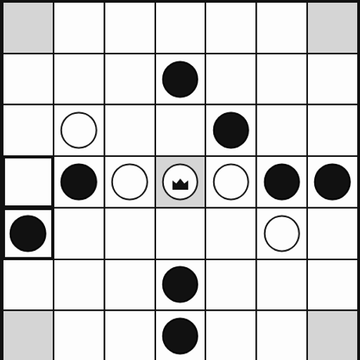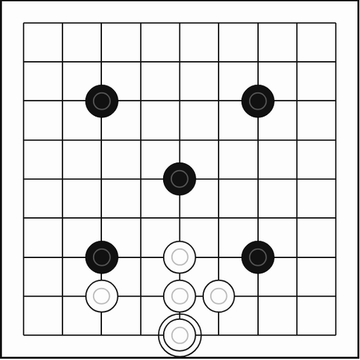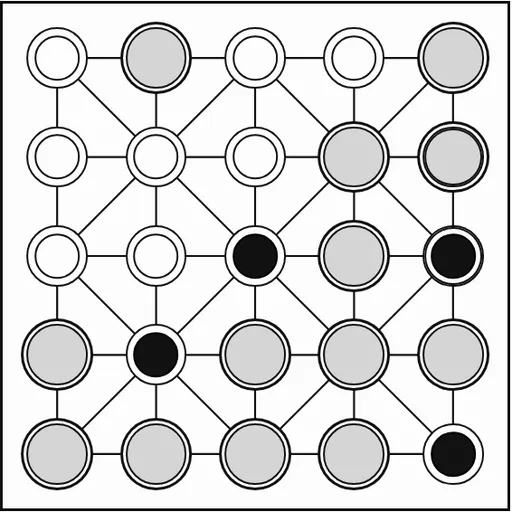
Bagh-Chal is a traditional hunting game from Nepal, and the name means “move the tiger.” Four tigers begin on the corners of a 5x5 grid of lines, and twenty goats wait to enter. The tigers try to capture five goats, while the goats try to surround the tigers so none of them can move.
How Bagh-Chal Works
Play comes in two phases. First, the goat side places one goat per turn on any empty point, while the tigers can already move and capture. This continues until all twenty goats have been placed.
Next, both sides move one piece per turn one step along a line to a free neighboring point. Every point has lines across and up and down, but only some have diagonals, so check the board drawing before a diagonal move.
A tiger captures by jumping over an adjacent goat in a straight line onto the empty point right behind it. The goat is removed. A count under the board shows goats placed and goats captured out of five.
Your First Few Minutes
- Pick a side, choose Easy, and press New game.
- As the goats, start placing goats along the edges of the board.
- Before each placement, check whether a tiger could jump that goat.
- As the tigers, look for goats with an empty point behind them.
- Turn on move suggestions if you want the game to mark movable pieces.
Controls for Bagh-Chal
| To do this | Keyboard | Mouse | Touch screen |
|---|---|---|---|
| Place a goat | Arrow keys to reach a point, Enter to place | Click an empty point | Tap an empty point |
| Move or capture | Arrow keys and Enter to pick the piece, then the target point | Click your piece, then the point it should go to | Tap your piece, then the target point |
| Start a game against the computer | not used | Click "vs Computer", choose goats or tigers and a level, then click "New game" | Tap "vs Computer", choose goats or tigers and a level, then tap "New game" |
| Take back a move | not used | Click "Undo" | Tap "Undo" |
| Show which pieces can move | not used | Turn on "Show move suggestions" in Settings | Turn on "Show move suggestions" in Settings |
What It Trains
Bagh-Chal is pure planning. As the goats you scan every tiger’s lines to make sure no goat has an open landing point behind it, often looking two or three turns ahead.
Playing the tigers sharpens a different habit. You search for forks, where one move threatens two goats at once, so the goat side cannot cover both.
Strategy Notes
- Goats: build from the border. A goat on the edge cannot be jumped from outside the board.
- Goats: close the gaps. A goat beside a tiger is only at risk if the point behind it is open.
- Goats: split the tigers. Tigers grouped together keep escape routes open for each other.
- Tigers: take the center. The middle point has eight lines and the most options.
- Tigers: attack early. The placement phase leaves the most holes to exploit.
Good to Know
Your game in progress saves in your browser and survives a reload, and Undo and Resign are always available. It works with mouse, touch and keyboard. This version comes from Christopher Müller’s open-source PaperGames collection.