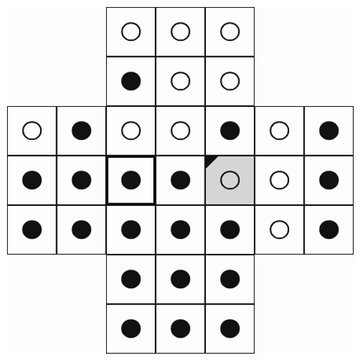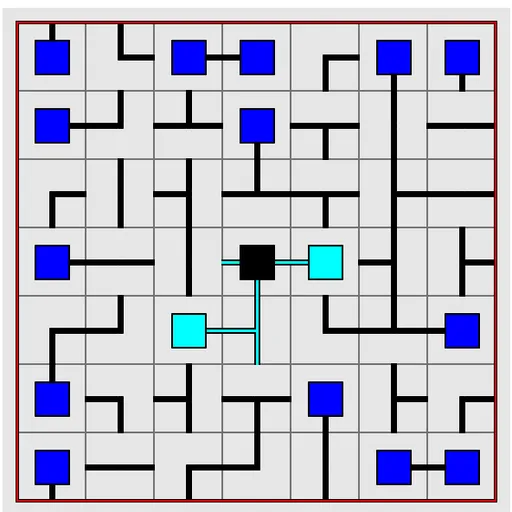
Net Pipe Puzzle gives you a plumbing grid where each piece was spun to a random angle. You twist the pieces back until every square is part of a single tree of pipes with no circuits. The puzzle is Net, written by Simon Tatham for his well-known free puzzle set.
How Net Pipe Puzzle Works
Four kinds of piece appear: stubs, straight runs, bends and three-way junctions. You cannot slide them anywhere, only spin them. The power hub is the black square close to the center, and anything joined to it is highlighted. Stub ends look like blue boxes when cut off and change to cyan once connected.
To finish, every tile must be in one connected network. On regular boards no pipe may aim at the border. Sizes go from 5x5 to 13x11, each with a wrapping twin in the Type menu, and the custom screen can scatter barriers, solid walls that double as hints.
You will not find hints, though a Solve option reveals the answer and undo and redo have no limit.
Your First Few Minutes
- Pick the smallest normal board from the Type menu.
- Look at the corner squares first, since each has very few legal turns.
- Turn edge tiles so no pipe points out of the board.
- Lock tiles you are sure of so they stay put.
- Work inward, joining pieces to the lit network until all are active.
Controls for Net Pipe Puzzle
| To do this | Keyboard | Mouse | Touch screen |
|---|---|---|---|
| Rotate a tile anticlockwise | Arrow keys to select, then A | Left-click | Tap |
| Rotate a tile clockwise | D | Right-click | Press and hold |
| Rotate a tile by 180 degrees | F | not used | not used |
| Lock or unlock a tile | S | Middle-click or Shift + click | not used |
| Shift a wrapping grid / move the light source | Shift + arrows / Ctrl + arrows | not used | not used |
| New game, undo, redo | N, U, R | Menu buttons above the grid | Menu buttons above the grid |
What It Trains
This puzzle builds logic. Each tile on the edge removes options for its neighbors, and you chain those small deductions until the board falls into place.
It also trains spatial thinking. You turn shapes in your head and picture how a corner or T-junction will meet the tiles around it.
Strategy Notes
- Start at corners. Without wrapping, a bend in a corner can face only one way, and a three-way piece is impossible there.
- Flat side to the wall. A junction along the border must keep its closed side facing out.
- Keep dead ends apart. Two end pieces facing each other would form a cut-off pair.
- Lock as you go. A locked piece is safe from accidental clicks.
- Save wrapping for later. Without walls, the easy edge clues disappear.
Good to Know
There is no sound, and the puzzle runs fully in the browser. We renamed the game and added press-and-hold for touch.