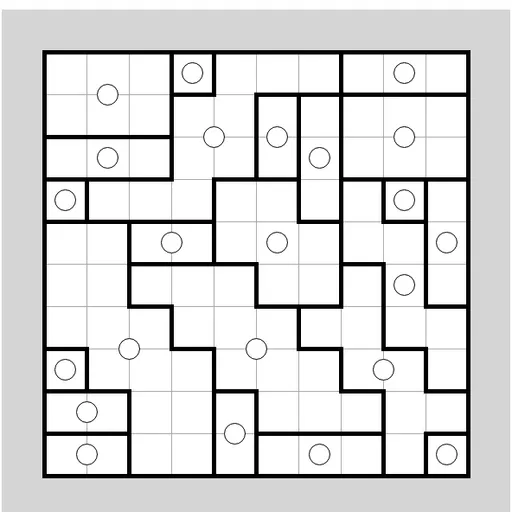
Galaxies Symmetry Puzzle is a grid of squares with small dots scattered across it. You add walls along the grid lines to split it into pieces, one piece per dot. Each piece has to look exactly the same after you spin it halfway around its own dot.
How Galaxies Symmetry Puzzle Works
Every square must end up in one region, and every region holds just one dot at its center. A dot can sit in the middle of a square, on the line between two squares, or on a corner where four meet. That tells you whether the center of its region is one square, two, or a block of four.
Symmetry here means a half turn. Pick any square in a region, find the square straight across the dot at the same distance, and that one must be in the region too. You draw walls by clicking or tapping lines, and the game highlights each region once it is closed, centered and symmetric with no stray wall inside.
Presets come in 7x7, 10x10 and 15x15, each in Normal or Unreasonable. Normal needs only steady deduction. Unreasonable may need a guess you later undo. Custom lets you choose your own size.
Your First Few Minutes
- Open the Type menu and choose 7x7 Normal.
- Find two dots in neighboring squares and wall the line between them.
- Pick a corner square and ask which dot could claim it with a mirror square.
- Claim that square and its mirror, then draw the walls around them.
- Repeat until every region lights up.
Controls for Galaxies Symmetry Puzzle
| To do this | Keyboard | Mouse | Touch screen |
|---|---|---|---|
| Draw or erase a wall on a grid line | Arrow keys to move, then Enter on a line | Left-click the line | Tap the line |
| Drag a reminder arrow out of a dot | Enter on a dot to pick up, Enter again to drop | Right-drag from the dot to a square | Press and hold the dot, then drag |
| Move or delete an arrow | not used | Right-drag it elsewhere, or off the grid | Press and hold it, then drag |
| New game, undo, redo | N, U, R | Menu buttons above the grid | Menu buttons above the grid |
What It Trains
You keep turning shapes in your head, checking where a square lands after a half spin. That is spatial reasoning. You also rule out dots one by one for a stubborn square, which is plain logic.
Strategy Notes
- Always claim in pairs. Any square you give a dot brings its mirror square along with it.
- Separate close dots first. Two dots in neighboring squares always need a wall between them.
- Start with lonely squares. If only one dot can reach a square symmetrically, it is settled.
- Drop arrows as notes. Mark a claimed square before you finish its walls.
- Trust the glow. A closed region that stays unlit has an extra wall or a broken mirror.
- Save Unreasonable for later. It can demand trial and error, so warm up on Normal.
Good to Know
Boards fit phones well, and turning sideways gives bigger squares on 15x15. There is no sound. This puzzle was written by James Harvey for Simon Tatham’s Portable Puzzle Collection.