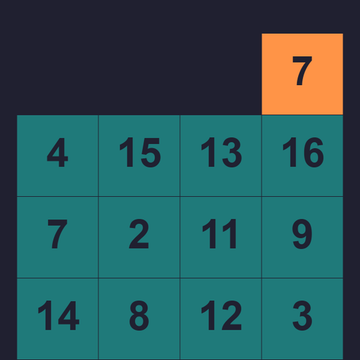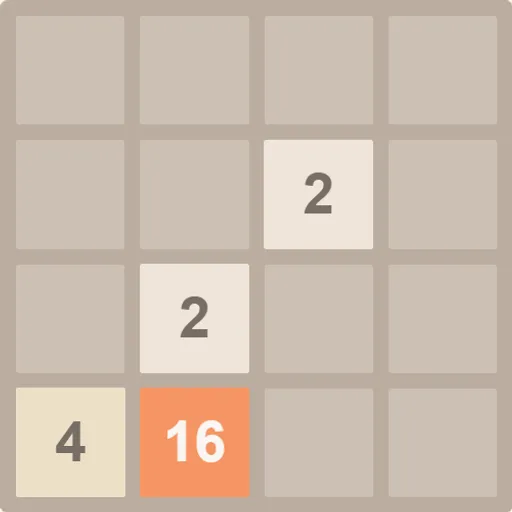
2048 is a sliding number puzzle on a small 4x4 grid. Each time you choose a direction, every tile on the board shifts at once, and equal numbers fuse into their sum. The goal is to keep doubling until one square shows 2048.
How 2048 Works
A fresh game places two tiles, each a 2 or a 4. Pick up, down, left or right and all tiles travel as far as they can that way. When two tiles holding the same value collide, they become one tile worth both added together, and that amount goes onto your score.
Any move that changes the board drops a new tile into a random empty square. It is usually a 2 and sometimes a 4. A move that changes nothing does not add a tile.
You win when a 2048 tile forms, and you may keep playing past it. The run is over once every square is filled and no neighbors match.
Your First Few Minutes
- Press an arrow key or swipe and watch how every tile moves together.
- Choose one corner, say bottom left, as the home for your largest tile.
- Mostly press Down and Left so tiles pile toward that corner.
- Use Right when you are stuck, and press Up only if nothing else works.
- If the board jams, press R or New Game and try the corner plan again.
Controls for 2048
| To do this | Keyboard | Mouse | Touch screen |
|---|---|---|---|
| Slide all tiles | Arrow keys, W A S D, or H J K L | not used | Swipe up, down, left or right |
| Start a new game | R | Click "New Game" | Tap "New Game" |
| Continue after reaching 2048 | not used | Click "Keep going" | Tap "Keep going" |
What It Trains
Every move asks you to add and double in your head, since you track which pairs will join and what they become. You learn powers of two without trying, from 8 and 16 up to 1024.
It also rewards planning. You look one or two moves ahead, picture where the new tile might land, and choose the move that keeps your big numbers lined up.
Strategy Notes
- Anchor one corner. Park your top tile in a corner and avoid any move that drags it away.
- Line up a falling chain. Arrange the edge row in shrinking order, such as 128, 64, 32, 16, so merges roll toward the corner.
- Lean on two directions. With a bottom-left corner, Down and Left do most of the work.
- Keep the home row packed. A full edge row cannot slide sideways, so your largest tile stays locked in place.
- Free trapped small tiles. A stray 2 wedged between big values can block a row, so clear it early.
Good to Know
Progress and your best score save in your browser automatically. It runs well on phones with swipes, and an upright screen gives the board the most space. Arrow keys, W A S D and H J K L all work on a keyboard. This is Gabriele Cirulli’s open-source game from 2014, shared under the MIT license.