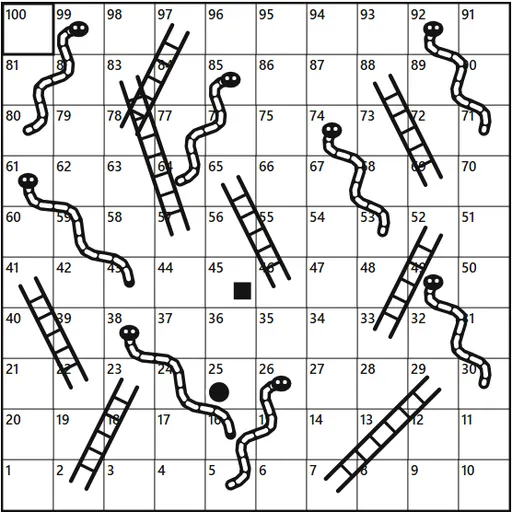
Snakes and Ladders is a dice race the whole family can share. Each roll carries your piece forward, ladders lift it up, and snakes drag it back. Whoever lands on the final field first is the winner. This black-and-white version has a full board of 100 fields plus a short 50-field one, and two to four people can play on one screen.
How Snakes and Ladders Works
Every piece waits beside the board and comes on with its opening roll. The fields wind back and forth from the bottom left, one row left to right and the next right to left. Press Roll and the piece steps ahead by the number on the die.
Stop at the bottom of a ladder and you climb to its top. Stop on a snake’s head and you slide down to its tail. The big board holds eight ladders and eight snakes, and the 50-field board has four of each across five rows.
Before you start, choose the board, the finish rule, how many players there are and how many the computer runs. Every player picks a shape for their piece, with four to choose from. A line of text reports each ladder and snake, and a small log below the board keeps the latest moves.
Your First Few Minutes
- Pick a board and the number of players.
- Choose token shapes and who starts, then press New game.
- Tap Roll and watch your token move.
- Follow the status line when a ladder or snake changes your spot.
- Keep rolling until someone reaches the last field.
Controls for Snakes and Ladders
| To do this | Mouse | Touch screen |
|---|---|---|
| Roll the die | Click "Roll" | Tap "Roll" |
| Let a computer player take its turn | Click "Continue" | Tap "Continue" |
| Set up the next game | Choose board, finish rule, players, computers and who starts, then click "New game" | Choose board, finish rule, players, computers and who starts, then tap "New game" |
| Show the setup again during a game | Click "Menu" | Tap "Menu" |
What It Trains
For young players, the game is gentle counting practice. They can count each step out loud and then compare with the log, which records the number rolled and where the piece began and finished.
Waiting for turns and following the zigzag path also builds attention, especially on the longer board.
Strategy Notes
- Choose the short board for little kids. Fifty fields keep a game brief and easy to follow.
- Try the exact rule for close finishes. Needing the precise number keeps trailing players in the race.
- Keep tap mode on with children. Pressing Continue gives everyone time to see each computer move.
- Review the log after a snake. Kids can count from the old field to the new one.
- Let kids pick a shape. A star or triangle is easy to spot among snakes and ladders.
Good to Know
The game plays with mouse or touch and fits a phone held upright. It comes from Christopher Müller’s PaperGames collection under the MIT license, with the board, snakes and ladders drawn in SVG and CSS.