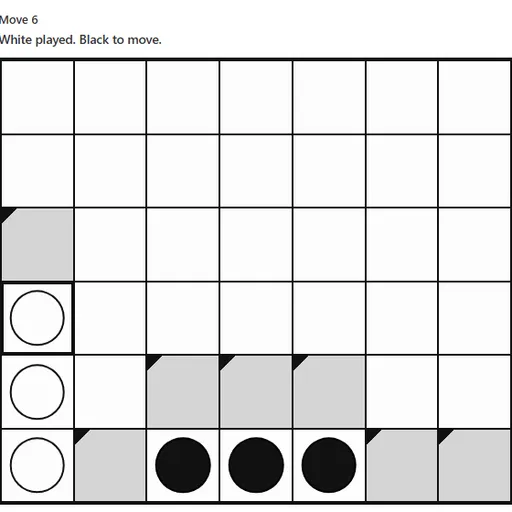
Four in a Row puts a standing grid, seven columns wide and six rows tall, between two players. One side drops black discs and the other drops white, one per turn, and whoever links four of their own first takes the round. The line can be flat, upright or diagonal.
How Four in a Row Works
Black always opens. When it is your move, choose a column. Clicking any cell in it works, since the disc falls to the lowest open slot. Each column shows a shaded landing cell, marked in its corner, so you can see where a disc would stop. A column that is full cannot take more.
Four touching discs of one color in an unbroken line win at once. A full grid with no winner counts as a tie. Easy drops discs at random, Medium checks one move ahead with a dash of chance, and Hard looks far down the game tree and likes to set up two threats together.
Choosing 2 Player (local) removes the computer so two people share one screen, and the status line keeps track of who is up.
Your First Few Minutes
- Choose vs Computer, pick black, set Easy and press New game.
- Drop your first disc in the middle column.
- After each drop, check whether the computer has three in a line.
- Try to set up two different spots where one more disc would win.
- Move up to Medium once you win most games on Easy.
Controls for Four in a Row
| To do this | Keyboard | Mouse | Touch screen |
|---|---|---|---|
| Drop a disc | Arrow keys to reach a column, Enter to drop | Click any cell in the column | Tap any cell in the column |
| Pick a game mode | not used | Click "2 Player (local)" or "vs Computer" | Tap "2 Player (local)" or "vs Computer" |
| Start a game against the computer | not used | Choose a disc color and level, then click "New game" | Choose a disc color and level, then tap "New game" |
| Take back your last move | not used | Click "Undo" | Tap "Undo" |
| Give up the current game | not used | Click "Resign" | Tap "Resign" |
What It Trains
You plan a few drops ahead and imagine where each disc will land, which builds strategy and spatial sense. Blocking also needs logic, since you must spot when filling a slot would give your opponent the cell right above it.
Strategy Notes
- Own the center. The middle column is part of more possible lines than any other.
- Make double threats. One open three is easy to stop, but two winning cells cannot both be blocked.
- Do not fill under a threat. Dropping right below your opponent’s winning slot hands it to them.
- Think about row parity. Counting up from the bottom, black usually profits from threats on odd rows in the endgame, while white profits from even ones.
- Scan the slants. Diagonal lines are the ones most often missed, by both sides.
Good to Know
Christopher Müller built this version for his open-source PaperGames set, using simple discs with strong contrast. It works with mouse, touch or keyboard and fits a phone. A check pops up before you resign or restart, so a stray tap will not end your round.