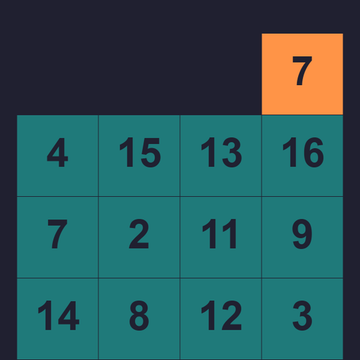
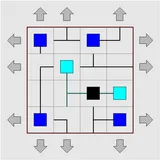
Netslide Pipe Puzzle takes a plumbing grid and shuffles where the pieces sit, without changing which way they face. To repair it, you shove a full line of tiles one step, and whatever drops off the far end wraps to the near end. Richard Boulton created this variant for Simon Tatham’s free collection.
How Netslide Pipe Puzzle Works
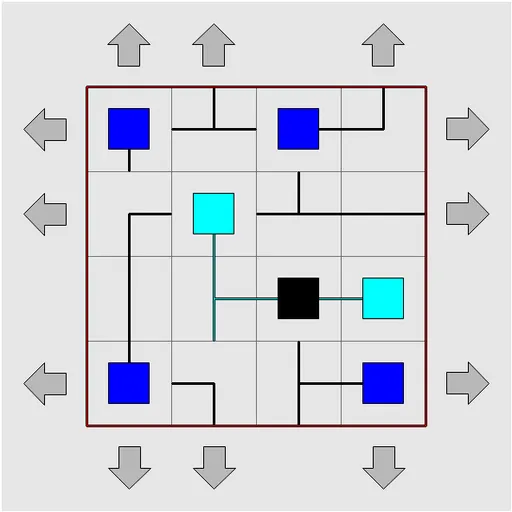
Small grey arrows frame the board, two per line. Clicking one nudges its line a single step that way, and a right-click nudges it back. The black piece is the hub, and pieces joined to it are tinted cyan or teal.
You win when all pieces connect into one tree with no circuits. Below the board, a line reports how many moves you have made and how many pieces are powered, for example 4/16. Get every piece powered and the board blinks with the word COMPLETED.
Presets cover three sizes, from 3x3 to 5x5, at three levels each. The custom screen lets you choose dimensions, edge wrapping and how many barriers appear.
Your First Few Minutes
- Choose the 3x3 easy board.
- Study the red barriers to see where pieces cannot connect.
- Find the source tile and work out which tiles must sit next to it.
- Slide one row and watch how every tile in it moves.
- Complete the uppermost row before moving lower.
Controls for Netslide Pipe Puzzle
| To do this | Keyboard | Mouse | Touch screen |
|---|---|---|---|
| Slide a row or column in the arrow's direction | Arrow keys to move the marker around the edge, then Enter | Left-click an arrow | Tap an arrow |
| Slide a row or column the opposite way | not used | Right-click an arrow | Press and hold an arrow |
| New game, undo, redo | N, U, R | Menu buttons above the grid | Menu buttons above the grid |
What It Trains
Netslide is a strong spatial workout. You picture where each tile will end up after a slide and keep track of a whole line moving at once.
It also builds logic and planning. Since one move disturbs a full row, you plan short sequences, such as shifting a column, adjusting a row and shifting the column back.
Strategy Notes
- Start small with barriers. Easy 3x3 boards show most of the answer through their red lines.
- Finish one line at a time. Settle a row fully, then try not to disturb it while solving the rest.
- Use the out-and-back trick. Shift a column away, adjust the row it crossed, then return the column.
- Reverse with right-click. Moving backward is quicker than looping a long line all the way around.
- Count dead ends. Every stub has to plug into a route that reaches the hub.
Good to Know
With a finger, a tap on an arrow shifts its line and a long press shifts it backward. Keyboard play works too. There is no sound. We renamed the game and added touch support.