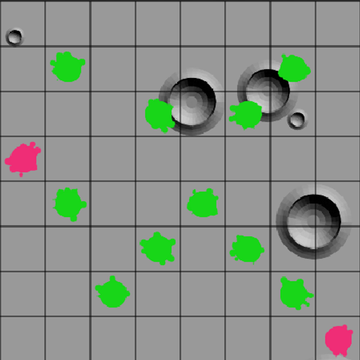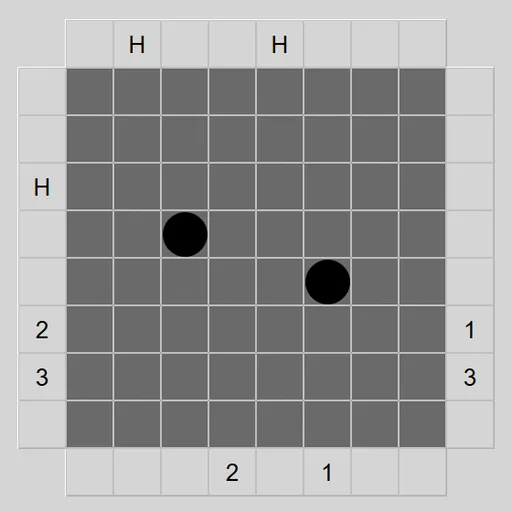
Black Box Lasers is a deduction puzzle with several balls tucked out of sight in a dark grid. They stay invisible, so you probe the box by shooting lasers in from its edges and studying the results. The goal is to work out exactly where every ball sits using the clues the beams leave behind.
How Black Box Lasers Works
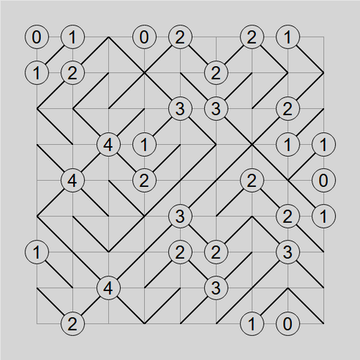
Click a light edge square to send a beam straight in. Hit a ball head-on and the laser is swallowed, marked with an H. Pass close to a ball on a diagonal and the laser bends a quarter turn to steer clear of it. When the laser comes back out its own entry square, or gets turned away on the very first cell, an R appears.
When a beam leaves from a different edge square, the same number marks both the entry and the exit. A single beam can turn more than once before it leaves.
Clicking a cell inside marks a guessed ball. After you have placed as many guesses as there are balls, a check button shows up at the upper left corner. A wrong guess gets a small hint, and Solve shows the full layout.
Your First Few Minutes
- Start with a small preset so the paths are easy to follow.
- Fire a beam down a middle row and note the result.
- Fire more beams from the sides to narrow down each ball.
- Mark balls inside the box where the clues agree.
- When the count matches, press the check button.
Controls for Black Box Lasers
| To do this | Keyboard | Mouse | Touch screen |
|---|---|---|---|
| Fire a laser | Arrow keys to an edge square, then Enter | Left-click a square on the edge | Tap a square on the edge |
| Place or remove a guessed ball | Arrow keys inside the box, then Enter | Left-click inside the box | Tap inside the box |
| Lock a square, row or column | Space | Right-click a square, or an edge square for its whole row or column | Press and hold |
| Check your guesses | Move to the button in the top left corner, then Enter | Click the button that appears in the top left corner | Tap the button that appears in the top left corner |
| Undo, redo, new box | U / R / N | Undo move, Redo move and New game buttons | Undo move, Redo move and New game buttons |
What It Trains
This is a logic puzzle at heart. Each result rules out positions, and you combine clues, such as an H on one row and a number pair on another, to narrow down a ball.
It also builds spatial reasoning. You picture the beam turning 90 degrees around a ball, and sometimes turning again, to see where it should come out.
Strategy Notes
- Probe the center. A beam through the middle quickly shows whether balls are nearby.
- Follow every H. The ball sits on that laser’s route, maybe past a turn.
- Consider all reasons for R. It may mean a ball next to the entry or a beam that bent back.
- Double-check straight passes. A pair of turns may undo each other, so test a clear lane twice.
- Lock empty areas. Locked squares and rows stop accidental ball marks.
- Aim for few shots. The fewer beams you fire, the better the solve.
Good to Know
It plays with mouse, keyboard or touch and offers five presets plus custom sizes and ball counts. The default 8x8 box hides five balls. James Harvey created it as part of the puzzle set kept by Simon Tatham, adapting a board game Eric Solomon published in 1977.