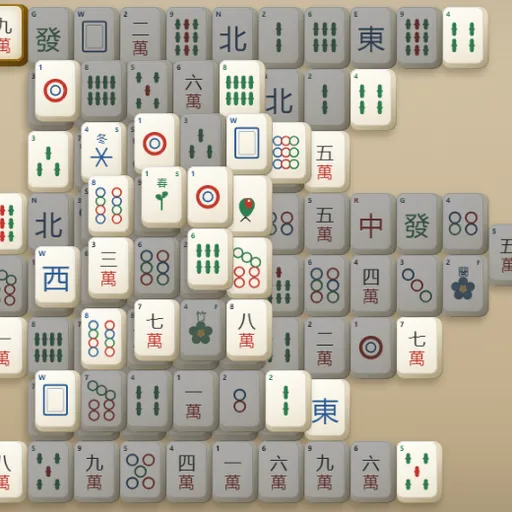
Mahjong Solitaire is a one-player matching puzzle built from a full set of 144 tiles piled into a layered shape. Your goal is to empty the table by lifting off identical pairs, but only tiles that are open can be taken. Planning the order of your pairs matters far more than clicking fast.
How Mahjong Solitaire Works
A tile counts as open when no tile rests on it and at least one of its long sides, left or right, is clear. Locked tiles appear dimmed. Select one open tile, then select another open tile with the same face, and both leave the board.
The set holds three number suits (circles, bamboo and characters), plus winds, dragons, flowers and seasons. Flowers are special: any flower pairs with any other flower. Seasons work the same way among themselves, and both carry a small F or S in the corner.
A round ends when the table is empty or when no open pairs remain. In the stuck case a panel appears and offers a shuffle that keeps the remaining tiles solvable, an undo, or a new deal. After a win you can replay that exact deal.
Your First Few Minutes
- Open the menu and choose Terraces, the layout with the most open pairs at the start.
- Scan the board for bright, undimmed tiles and find two with matching faces.
- Click the first tile, then its partner, and watch both disappear.
- Press H if you cannot spot a move, keeping in mind it lowers your score a little.
- Keep an eye on the pairs-open counter, and when it gets low, think before each match.
Controls for Mahjong Solitaire
| To do this | Keyboard | Mouse | Touch screen |
|---|---|---|---|
| Pick up a tile, then take a matching pair | Tab into the board, arrows to move, Enter or Space to select | Click a free tile, then click its match | Tap a free tile, then tap its match |
| Put the selected tile back | Esc | Click the same tile again | not used |
| Show a pair you can take | H | Click "Hint" | not used |
| Undo the last pair | Z | Click "Undo" | not used |
| Reshuffle the tiles still on the board | S | Click "Shuffle" | not used |
| Start a new deal | N | Click "New game" | not used |
What It Trains
Each match is a small logic choice. When three copies of a face are open, you have to work out which pair frees the most tiles underneath and beside it. That is reasoning about cause and effect a few moves ahead.
The stacked layouts also build spatial sense. You learn to read which tiles sit on higher layers and which edges will open next, and long sessions reward steady focus over guessing.
Strategy Notes
- Dig into tall piles first. Tiles buried under several layers hold up many others, so uncovering them early keeps options open.
- Work rows from the outside in. A tile in the middle of a row stays locked until a neighbor at one end is gone.
- Count all four copies. Before you match, check where the other copies of that face sit and pick the pair that frees more.
- Save flowers and seasons. Since any two of a group match, they make useful spare moves when the board tightens.
- Slow down at one or two open pairs. That is the moment to look for a move that unlocks fresh tiles rather than the first match you see.
Good to Know
There are light and dark table themes, and the synthesized sound effects can be turned off. On a phone the whole board scales down, so wide layouts get tiny tiles; landscape or full screen helps. Tile faces are drawn as SVG in code, and the project is MIT licensed.