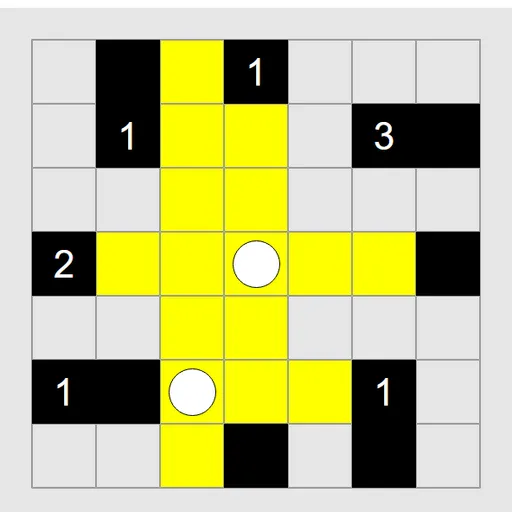
Light Up Lamp Puzzle is a logic grid of white and black squares. You place light bulbs on white squares, and each bulb throws light along its row and column until a wall stops it. The goal is to light every white square while obeying the number clues on some black walls.
How Light Up Lamp Puzzle Works
A bulb lights its own square, then beams straight up, down, left and right. The light ends at a black square or the edge of the board. Every lit square turns yellow, so you can see coverage at a glance.
Two bulbs may never shine on each other, which means no two bulbs can share an open row or column segment. A numbered black square needs exactly that many bulbs in the squares touching its sides. Corners do not count. Black squares without a number simply block light.
You can mark a square as unable to hold a bulb. Marks are just notes, but they are the main way to track deductions on bigger boards. Undo, redo and a Solve button are in the menu.
Your First Few Minutes
- Start with a 7x7 easy board from the Type menu.
- Find any 0 clue and mark all four of its neighbors.
- Find any 4 clue and put bulbs on all four sides.
- Look for dark squares that only one spot can light, and place a bulb there.
- Check for red after each bulb and fix clashes straight away.
Controls for Light Up Lamp Puzzle
| To do this | Keyboard | Mouse | Touch screen |
|---|---|---|---|
| Place or remove a bulb | Arrow keys to move, then Enter | Left-click a white square | Tap a white square |
| Mark a square that cannot hold a bulb | Space or I | Right-click a white square | Press and hold a white square |
| New game, undo, redo | N, U, R | Menu buttons above the grid | Menu buttons above the grid |
What It Trains
Light Up is a deduction puzzle. You prove where bulbs must go and where they cannot, using clues and beams together. Each placed bulb rules out many squares, and that often forces the next move.
It also builds spatial sense, since you track long beams across the grid and see which dark squares are still reachable.
Strategy Notes
- Mark around zeros at once. A 0 bans bulbs from every square beside it.
- Fill full clues. A 4 needs all four sides, and a 3 against the edge needs all three open sides.
- Hunt for single sources. A dark square that only one spot can light tells you exactly where a bulb goes.
- Use corner clues. A 2 in a board corner has only two neighbors, so both get bulbs.
- Let marks cut options. Marked squares narrow the places a beam can come from.
- Fix red quickly. A clash is easiest to undo right after you cause it.
Good to Know
Mouse, keyboard and touch all work, and press and hold places marks on phones. James Harvey wrote this puzzle for Simon Tatham’s Portable Puzzle Collection.