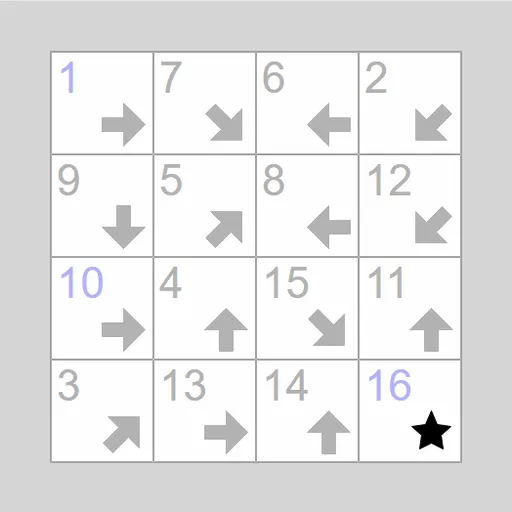
Signpost Arrow Chain is a grid puzzle where each square holds an arrow and a few hold numbers. You link the squares into one chain, from 1 up to the last number, so that every arrow points toward the next square in line. It is the Signpost puzzle from Simon Tatham’s Portable Puzzle Collection, written by James Harvey.
How Signpost Arrow Chain Works
The grid has one square for every number, so a 4x4 board counts from 1 to 16. The first and last numbers are always visible, and the final square shows a star. Some boards reveal a few numbers in the middle as extra help.
Each square must point at the one after it, at any distance along a straight or diagonal line. Pressing on a square lights up every square it could legally link to. Drag forward to set a successor, or right-drag to set a predecessor.
Chains you build without numbers get letter labels until they meet a numbered square. A small dot marks squares that still need something pointing into them, and an arrow turns grey once its square has a successor. Drag a square off the grid to break its links.
Your First Few Minutes
- Open a 4x4 board and find squares 1 and 16.
- Press on square 1 to see which squares its arrow can reach.
- Look for squares only one arrow can reach and link those first.
- Build short lettered chains wherever a link is certain.
- Join the pieces until the whole board forms one sequence.
Controls for Signpost Arrow Chain
| To do this | Keyboard | Mouse | Touch screen |
|---|---|---|---|
| Link a square to the one that comes next | Arrow keys to move, Enter on the first square, Enter again on the next | Left-drag from a square to its successor | Drag from a square to its successor |
| Link a square to the one that comes before it | Space on a square, then Space again on its predecessor | Right-drag from a square to its predecessor | Press and hold, then drag (or set Tap to Link backward) |
| Break the links of one square | not used | Left-drag the square off the grid | Drag the square off the grid |
| Break a whole chain | not used | Right-drag any square of the chain off the grid | Press and hold, then drag off the grid |
| New game, undo, redo | N, U, R | Menu buttons above the grid | Menu buttons above the grid |
What It Trains
This is a pure deduction puzzle. You look at a square and ask which arrows on the board could possibly land there, then rule out options one at a time. Reading arrows across the grid also trains your eye for lines and diagonals.
Long chains need steady focus, since a single wrong link early on can throw off the numbers later.
Strategy Notes
- Start from the star. Only squares whose arrows point at the last square can sit just before it.
- Hunt for single options. If only one arrow can reach a square, that arrow’s square is its predecessor.
- Follow the dots. A square without a dot already has a predecessor, so nothing else should link into it.
- Build loose chains early. Lettered segments often lock into place once one end reaches a number.
- Clear tangles fast. Right-drag any square of a chain off the grid to remove the whole chain.
Good to Know
Undo, redo and a Solve option are built in, and touch screens support dragging plus press and hold. The board fits phones in either orientation. We renamed the puzzle and added touch controls, but the puzzle code is unchanged from the official web build.