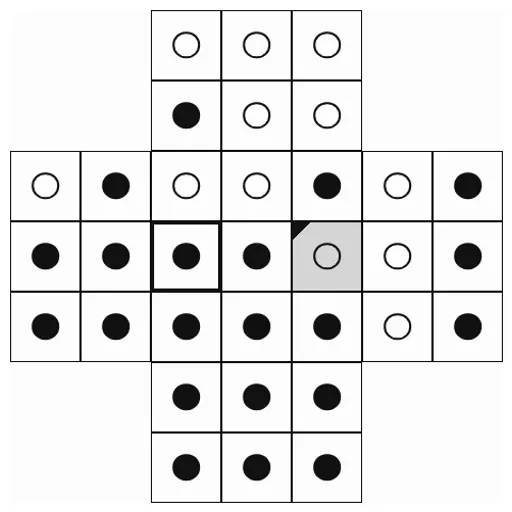
Peg Solitaire is a solo board puzzle with one move type and a tough target. All holes except one begin with a peg in them. Each hop removes a peg, and you win by reducing the whole board to a single survivor.
How Peg Solitaire Works
Choose a peg and the game marks every empty hole it can land in. A legal hop goes exactly two spaces in a straight line, over a neighboring peg, into an empty hole. The peg you hopped over leaves the board, and a counter shows how many are left.
There are six layouts: the English cross (33 holes), the European board (37), a 45-hole German cross dated 1779, a 6 by 6 square, a 41-hole diamond and a 15-hole triangle. Every starting position has been checked as solvable. The European board opens with the hole just above the center empty, since its center start cannot be solved.
Your First Few Minutes
- Pick the 15-hole triangle from the board list and press New game.
- Tap any peg next to the empty hole and watch which targets light up.
- Tap a marked hole to make the hop, then check the peg counter.
- Keep going until no hop is possible, and note how many pegs remain.
- Press Undo a few times and try a different order to beat that number.
Controls for Peg Solitaire
| To do this | Keyboard | Mouse | Touch screen |
|---|---|---|---|
| Select a peg | Tab to the peg (arrow keys move across the board), then Enter | Click the peg | Tap the peg |
| Jump into a hole | Move to the marked empty hole, then Enter | Click a marked empty hole two spaces away | Tap a marked empty hole two spaces away |
| Take back a jump | not used | Click "Undo" | Tap "Undo" |
| Change board or restart | not used | Choose a board, then click "New game" | Choose a board, then tap "New game" |
What It Trains
This puzzle is about looking ahead. Before each hop you ask which pegs it will leave stranded two or three moves later, and that habit of tracing consequences is plain logic.
It also works your spatial sense. You learn to see a board as zones, such as one arm of a cross, and to clear each zone while keeping the remaining pegs connected.
Strategy Notes
- Never strand a peg. A peg with no neighbors can’t hop and can’t be hopped, so one lonely peg ruins the run. Scan the edges first.
- Finish one region before the next. On the cross layouts, empty one arm fully rather than nibbling at all four.
- Learn the three-peg pattern. Short repeated sequences can wipe out a line of three while the rest stays linked.
- Warm up on small boards. The triangle and the square teach the habits you need for the bigger crosses.
- Back up early. When a peg is about to be cut off, undo several hops instead of pushing on.
Good to Know
Undo is unlimited during a game, and your position stays saved in the browser after a reload. The boards are drawn in black and white with no sound. You can move with the arrow keys, a mouse or touch, so it fits phones well. Christopher Müller wrote it as part of his open-source PaperGames set.