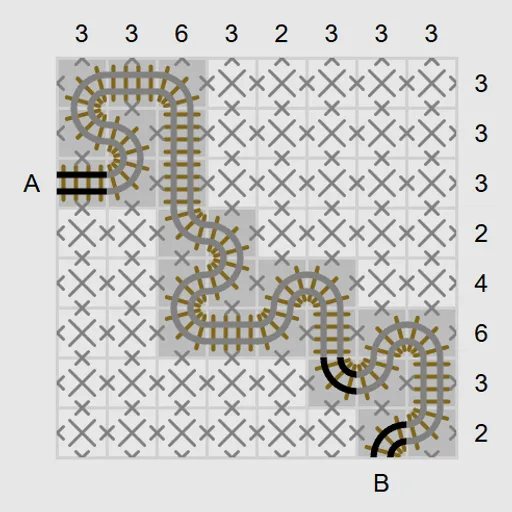
Train Track Logic is a grid puzzle about finishing a railway. Two ends of the line, marked A and B, sit on the edges of the map, and a few rail pieces are already laid. Your goal is to connect A to B with one route so that each row and column has exactly the number of track squares its clue shows.
How Train Track Logic Works
The route enters at A on the left side and exits at B on the bottom. It may use only straight rails and right-angle curves. It cannot branch, cross over itself or form a loop.
Numbers across the top count track squares in each column, and numbers on the right count them in each row. Every square on the route uses exactly two of its four sides.
You lay rails by clicking the edge between two squares, which joins them. Right-clicking an edge puts a cross there to show the line cannot pass. Inside a square, a left click adds a marker for “track goes here” and a right click adds a cross for “no track.” Dragging marks a whole line at once. The Type menu has twelve presets from 8x8 to 15x15 at Easy, Tricky or Hard.
Your First Few Minutes
- Pick an 8x8 Easy preset from the Type menu.
- Find rows or columns with a 0 and drag crosses across them.
- Find lines whose clue equals their length and mark every square as track.
- Extend each printed rail piece into the square it points at.
- When a square has two crossed-out sides, lay rails on the other two.
Controls for Train Track Logic
| To do this | Keyboard | Mouse | Touch screen |
|---|---|---|---|
| Lay a track piece across an edge | Arrow keys to move onto an edge, then Enter | Left-click the edge between two squares | Tap the edge with Tap set to Track |
| Mark an edge as "no track here" | Space on an edge | Right-click the edge | Press and hold the edge, or set Tap to Cross and tap |
| Mark a square as "has track" / "no track" | Enter / Space on a square | Left-click / right-click inside the square | Tap / press and hold inside the square |
| Mark a whole line of squares | not used | Left- or right-drag across several squares | Drag (press and hold first for crosses) |
| New game, undo, redo | N, U, R | Menu buttons above the grid | Menu buttons above the grid |
What It Trains
Each square is a tiny rule check. You ask which two sides the track could use and cross off the rest, then follow the effects to the next square. Holding the row and column counts in mind while the route bends across the map is good practice for careful, step-by-step logic.
Strategy Notes
- Settle the extreme clues. Zeros and full lines are free information.
- Use the two-sides rule. Two blocked edges on a track square force the other two.
- Grow from given pieces. Each one names a neighbor that must hold track.
- Cross out filled lines. Once a clue is met, mark the rest of that line as empty.
- Never close a loop. A loop can never connect both A and B.
- Plan your turns. Reaching a distant column means the line has to bend toward it somewhere.
Good to Know
You can play with a mouse, keyboard or touch, where a Tap setting switches between track and crosses. There is no timer and no sound. James Harvey wrote this puzzle for Simon Tatham’s Portable Puzzle Collection.