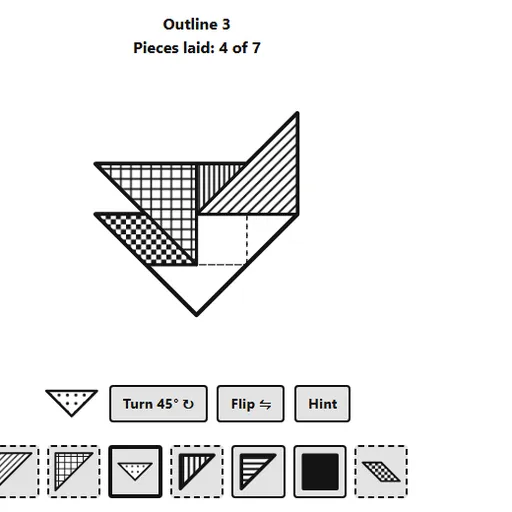
Tangram is the classic Chinese dissection puzzle built from seven flat pieces that together form a square. Your goal is to arrange all seven inside a silhouette with no overlaps and no empty gaps. This version uses patterned black-and-white pieces and works entirely by tapping, so you never have to drag.
How Tangram Works
The pieces sit in a tray under the outline. Tap one to select it, then use Turn 45° to rotate it or Flip to mirror it. Tap inside the outline and the piece snaps to the closest place where it fits.
Tapping a piece that is already on the board picks it back up. There are 61 outlines across Easy, Medium and Hard, plus 29 in a set called Outline only.
The Outline only set plays differently. It shows just the outer edge, and pieces stay exactly where you tap, even when they hang over the border. That makes it feel closer to moving real pieces by hand.
Your First Few Minutes
- Open an Easy outline and look at the faint guide lines.
- Tap a large triangle in the tray, turn it to match a guide, and tap it into place.
- Add the second large triangle, since the two cover half the shape.
- Fit the medium triangle, the square and the small triangles next.
- Finish with the parallelogram, flipping it if it will not fit.
Controls for Tangram
| To do this | Mouse | Touch screen |
|---|---|---|
| Choose a piece | Click the piece in the tray below the outline | Tap the piece in the tray below the outline |
| Turn or flip the chosen piece | Click "Turn 45°" or "Flip" | Tap "Turn 45°" or "Flip" |
| Place the piece | Click inside the outline where it should go | Tap inside the outline where it should go |
| Pick a laid piece up again | Click the laid piece | Tap the laid piece |
| Get help | Click "Hint" to lay one piece correctly | Tap "Hint" to lay one piece correctly |
What It Trains
Tangram is pure spatial reasoning. You picture how a triangle will look after one or two 45-degree turns, and you notice that two small triangles cover the same area as the square. Each outline makes you break a big shape into smaller ones you already know.
Strategy Notes
- Start big. The two large triangles fill half the area and usually have only a few spots that work.
- Read the points. A sharp corner in the outline almost always holds a triangle tip.
- Leave the parallelogram for last. It is the only piece that changes when flipped, so test both sides at the end.
- Count your turns. Outlines line up with the grid or its diagonals, so a piece that looks crooked may need one more turn.
- Swap shapes in tight spots. Two small triangles can stand in for the square or the medium triangle.
- Let one hint unlock a shape. A single correct piece often makes the rest easy to see.
Good to Know
Every action is a tap, which makes Tangram easy on phones and tablets as well as with a mouse. Solved outlines are checked off in the list. It comes from Christopher Müller’s open-source PaperGames collection, with pieces drawn in code and no sound.