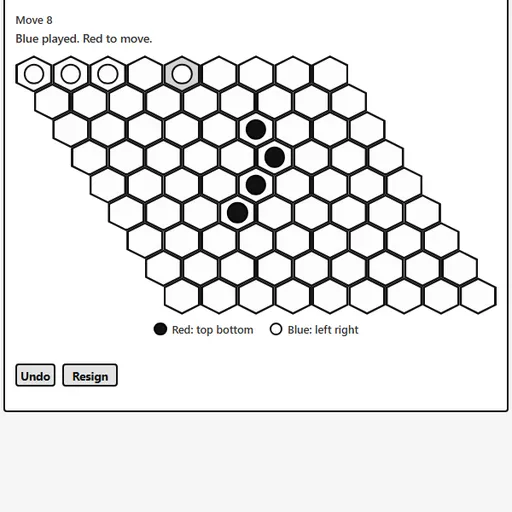
Hex is a board game about building a bridge of stones from one side to the other. The board is a 9x9 diamond made of hexagons, and each player owns a pair of opposite edges. Connect yours with an unbroken chain first and you win.
How Hex Works
Red always opens. After that, players alternate, each placing one stone of their color on any empty cell. Stones stay put for the whole game and can never be captured.
Red is trying to link the top edge to the bottom edge. Blue is trying to link left to right. Because every hexagon has six neighbors, a chain can twist and turn on its way across. A legend under the board reminds you which edges are yours, and the game names the winner as soon as a full path exists.
Since the two routes must cross, one of them always gets through. Each stone usually helps your chain and blocks the other one at the same time. You can play the computer at three levels, choosing Red or Blue, or play a friend on one screen.
Your First Few Minutes
- Pick Blue and Easy, then press New game.
- After Red moves, place a stone near the center.
- Add stones two cells apart with two shared empty neighbors, so they stay linked.
- When Red heads toward its edge, block a few rows in front, not right next to it.
- Extend your chain toward both of your edges.
Controls for Hex
| To do this | Keyboard | Mouse | Touch screen |
|---|---|---|---|
| Place a stone | Tab to the board, arrow keys to pick a cell, Enter to place | Click an empty hexagon | Tap an empty hexagon |
| Choose color and opponent | not used | Pick Red or Blue and a level, then click "New game" | Pick Red or Blue and a level, then tap "New game" |
| Take back a move | not used | Click "Undo" | Tap "Undo" |
| Give up | not used | Click "Resign" | Tap "Resign" |
What It Trains
You constantly picture paths across the board and find the narrow spots where a single stone cuts one off. That is spatial reasoning, mixed with strategy as you decide whether to attack or defend with each move.
Strategy Notes
- Claim the middle. A central stone can reach toward either of your edges.
- Build bridges. Two stones sharing two empty neighbors cannot be split; answer one gap by filling the other.
- Block from afar. A stone touching an enemy chain is easy to go around.
- Skip early edge stones. Stones that threaten several routes are worth more than ones on the rim.
- Mind the sharp corners. The two acute corners often decide late connections.
Good to Know
The board resizes for phones, tablets and computers in either orientation, with mouse, touch and keyboard controls. There is no sound. Undo and Resign are always ready, and settings cover text size, contrast, spacing and computer speed. It comes from Christopher Müller’s PaperGames collection.