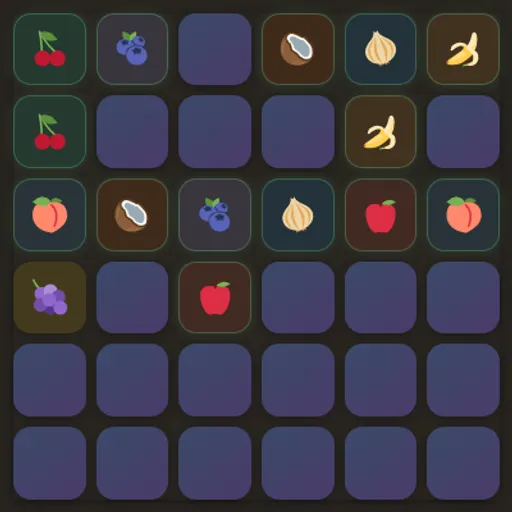
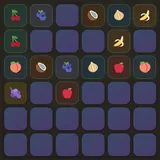
Memory Pairs is a classic card-flipping game with a dark, calm look and three board sizes to choose from. Every card hides a food picture, such as a pear or a croissant, and each picture is on exactly two cards. Your aim is to find every pair while using as few moves and seconds as possible.
How Memory Pairs Works
All cards begin face down. Choose one to turn it over, then choose a second. A match stays face up with a colored tint and a green outline. If the two pictures differ, both flip back after a brief pause.
Every pair of flips counts as one move. The timer stays at zero until your first flip and stops when the last pair is found, and then a message shows your moves and seconds. The 4x4 board has 8 pairs, 6x6 has 18 and 8x8 has 32, drawn from a set of 32 foods.
Changing the size in the menu deals a fresh shuffled board at once, and New game reshuffles your current size.
Your First Few Minutes
- Pick the 4x4 size from the menu below the board.
- Flip two cards you have not seen and note both pictures and spots.
- On each new move, flip an unknown card first.
- If it matches a picture you saw before, flip that remembered card next.
- When the board is clear, check your time and moves, then try again.
Controls for Memory Pairs
| To do this | Keyboard | Mouse | Touch screen |
|---|---|---|---|
| Flip a card | Tab to a card, then Enter or Space | Click a card | Tap a card |
| Start a new shuffled board | not used | Click "New game" | Tap "New game" |
| Change the board size | not used | Pick 4×4, 6×6 or 8×8 from the menu | Pick 4×4, 6×6 or 8×8 from the menu |
| Open or close the help window | Esc or Q closes it | Click "? man" to open, click outside to close | Tap "? man" to open, tap outside to close |
What It Trains
This is direct practice for short-term memory. You hold a growing map of pictures and positions in your head, and on the 8x8 board that can be dozens of cards at once.
It also builds focus. A card you saw for only a second is easy to lose if your attention drifts, and the move counter shows how well you kept track.
Strategy Notes
- Sweep in order. Turning cards row by row makes positions easier to recall than random jumps.
- New card first, known card second. Use your first flip to learn something, then use memory for the second.
- Note the tint. Each pair has its own background color, which can help you place a picture you glimpsed.
- Shrink the board early. On 8x8, clear the pairs you are sure of before taking guesses.
- Say it in your head. Naming a picture and its spot, like pear top left, can make it stick.
Good to Know
Memory Pairs works with a mouse, touch or keyboard (Tab and Enter or Space). On a small phone, 4x4 gives the largest cards. A short help window opens on your first visit. It comes from Tejas Wavde’s open-source collection, with pictures from the Twemoji font.