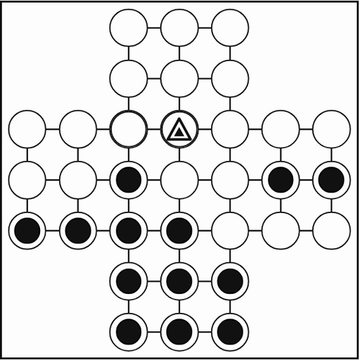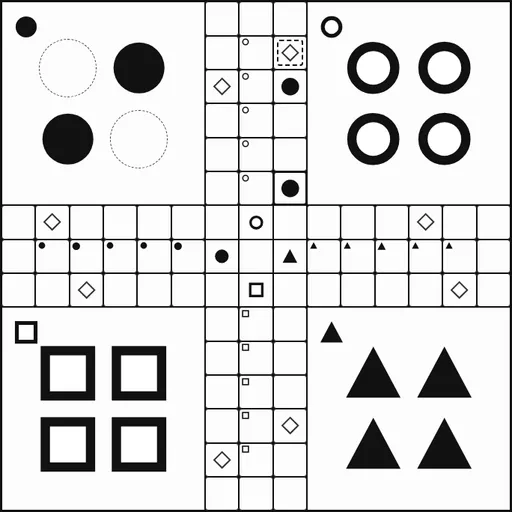
Ludo is the classic cross-shaped race game for two to four players. Every side owns four tokens that wait in a corner, and you want to march all of yours around the board and home before anyone else. Face up to three computer players or hand one device around a group of friends.
How Ludo Works
On your turn you roll the die and move one token forward by that number. A token stays in its corner until you roll a 6, and any 6 earns a bonus roll. A third 6 in a row, though, cancels the rest of your turn.
Everyone moves clockwise on the outer ring that all players share, and each token finishes by turning up a private lane that leads to the middle. Landing on a lone rival outside a safe square sends that token back to its base. The protected squares are every side’s entry square plus the diamond eight steps beyond it.
Because this edition was designed for monochrome displays, each side has a shape instead of a color, namely solid dots, rings, squares and triangles. A text line reports each roll and each move as it happens.
Your First Few Minutes
- Choose vs Computer, pick your token and set the level to Easy.
- Press New game and click Roll.
- When you roll a 6, bring a token out of your base.
- Move a token onto a diamond when a rival is close behind.
- Try to have two or three tokens on the track so you have choices.
Controls for Ludo
| To do this | Keyboard | Mouse | Touch screen |
|---|---|---|---|
| Roll the die | not used | Click "Roll" | Tap "Roll" |
| Move a token | Tab to the token's square (arrow keys move across the board), then Enter | Click the token you want to move | Tap the token you want to move |
| Take back your last move | not used | Click "Undo" | Tap "Undo" |
| Set up a game | not used | Pick vs Computer or Local hotseat, players, your token and level, then click "New game" | Pick vs Computer or Local hotseat, players, your token and level, then tap "New game" |
| Give up the current game | not used | Click "Resign" | Tap "Resign" |
What It Trains
Ludo mixes luck with real choices. Each roll asks which token to move, and you count squares to see which rival tokens could reach yours next turn.
That counting is simple math done again and again. You also weigh risk, such as racing ahead versus resting on a safe square.
Strategy Notes
- Spread your tokens. More tokens on the track mean more options for each roll.
- Measure the danger zone. A rival up to six squares behind can hit you next roll.
- Park on safe squares. Diamonds and starting squares protect a token from capture.
- Block the leader. A pair of your tokens parked ahead of someone close to finishing can stall them for turns.
- Plan the finish. Keep a second token on the track so a roll that is too big still has a use.
Good to Know
Computer players come in Easy, Medium and Hard, or use Local hotseat for two to four people on one device with no accounts. The game saves in your browser. Christopher Müller made it as part of his open-source PaperGames set.