The Royal Game of Ur is a two-player race from ancient Mesopotamia, known from boards found in royal tombs. Each side rolls dice and moves seven pieces along a path, and the first to bring all seven home wins. This version follows the modern reconstructed rules, and you can face a computer at three levels or a friend on the same screen.
How the Royal Game of Ur Works
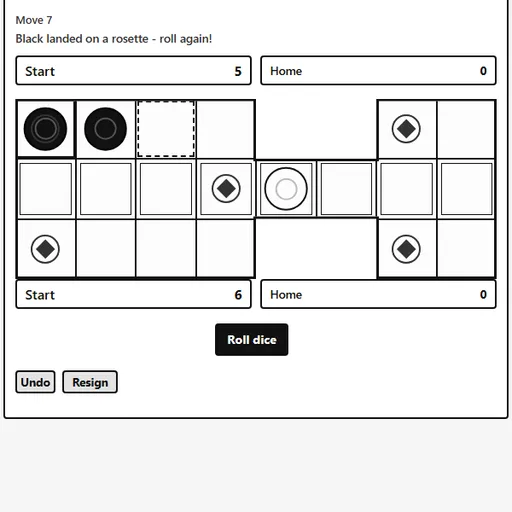
Every player has a path of 14 squares. The first four and the last two belong to you alone. The eight in the middle row are shared, and that is where the fighting happens.
Press Roll dice and four two-sided dice show a total from 0 to 4. Move one piece that many squares, either one on the board or a new one from Start. Highlighted pieces are the legal choices, and you can never land on your own piece. Landing on an enemy piece in the shared lane sends it home.
Rosettes, marked with a diamond, give you another roll and keep that piece safe. A piece only leaves the board with the exact number needed. On Hard, the computer also weighs how likely each exposed piece is to be hit.
Your First Few Minutes
- Pick a color and the easiest level, then press New game.
- Roll and bring your first piece onto your private squares.
- Aim for a rosette to earn a bonus roll.
- Watch the shared lane for enemy pieces you can hit.
- Keep bringing pieces home with exact rolls until all seven are off.
Controls for Royal Game of Ur
| To do this | Keyboard | Mouse | Touch screen |
|---|---|---|---|
| Roll the dice | Tab to "Roll dice" and press Enter | Click "Roll dice" | Tap "Roll dice" |
| Move a piece | Tab or arrow keys to a highlighted piece or the Start slot, then Enter | Click a highlighted piece, or the highlighted Start slot to enter a new piece | Tap a highlighted piece or the highlighted Start slot |
| Choose color and opponent | not used | Pick black or white and a level, then click "New game" | Pick black or white and a level, then tap "New game" |
| Undo or resign | not used | Click "Undo" or "Resign" | Tap "Undo" or "Resign" |
What It Trains
Each turn is a small risk check. You count how many squares separate your piece from an enemy one behind it and judge how likely a hit is, knowing that a 2 is the most common roll. That is practical probability, done by feel.
You also plan ahead across several pieces, deciding which to push, which to hold back and which to park safely.
Strategy Notes
- Own the center rosette. It sits in the shared lane, keeps your piece safe and blocks the other player from landing there.
- Worry most about two behind. An enemy one to three squares back can hit you, and two is the likeliest gap.
- Spend 1s on new pieces. A small roll is often best used to enter a fresh piece.
- Keep a guard at home. Pieces waiting before the shared lane can strike rivals that pass them.
- Spread out your finish. Since exits need exact rolls, pieces at varied distances make more rolls useful.
Good to Know
The board is drawn with CSS and works with mouse, touch or keyboard, so it fits phones and tablets. Two people can share one device. It comes from Christopher Müller’s PaperGames collection under the MIT license, trimmed to this one page in English.