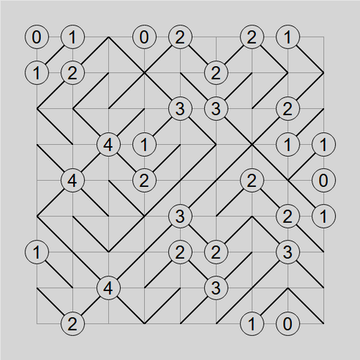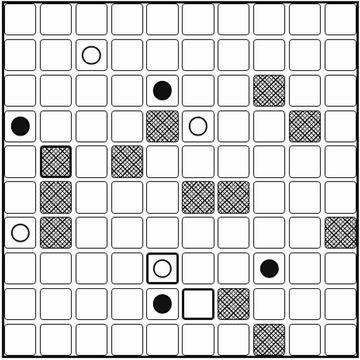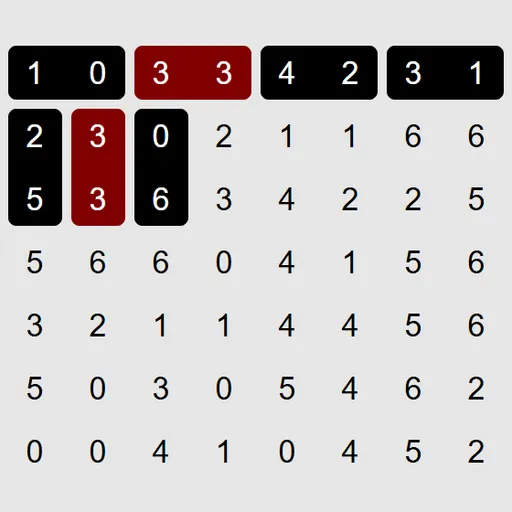
Dominosa Domino Logic starts after someone has already packed a whole domino set into a rectangle, copied down the numbers and then cleared the tiles away. You see only those numbers. Your job is to work out where each domino sat, so that every possible pair, doubles too, appears one time and no more.
How Dominosa Domino Logic Works
The usual board holds the numbers 0 to 6. That set has 28 dominoes, one for each pair, and it fills an 8x7 grid. Every domino covers two squares that touch along a side, either across or up and down.
To place a tile, click the gap between two neighboring numbers. Click the same gap to remove it. A new domino that overlaps older ones pushes them off. A right-click on a gap draws a small line instead, which is your private note saying no domino can go there.
When all squares are covered with no repeats, the puzzle is solved. Duplicates glow red right away. The Type menu offers smaller and larger sets, from numbers up to 3 through numbers up to 9, and four levels of logic.
Your First Few Minutes
- Open the Type menu and pick a small preset on Trivial so the grid stays short.
- Choose one pair, say 1-3, and scan the grid for every spot where a 1 sits beside a 3.
- If that pair can only fit in one place, lay the domino there.
- Draw lines across the other spots where that pair can no longer go.
- Repeat with new pairs until the grid is full, then try the standard 0 to 6 board.
Controls for Dominosa Domino Logic
| To do this | Keyboard | Mouse | Touch screen |
|---|---|---|---|
| Place or remove a domino | Arrow keys to a spot between two numbers, then Enter | Left-click between two neighboring numbers | Tap between two neighboring numbers |
| Draw or erase a "no domino here" line | Space | Right-click between two numbers | Press and hold between two numbers |
| Highlight every copy of a number | Type the number | Right-click on the number | Press and hold on the number |
| Undo, redo, new puzzle | U / R / N | Undo move, Redo move and New game buttons | Undo move, Redo move and New game buttons |
What It Trains
This puzzle is pure deduction. You hold a list of 28 pairs in mind, check each one against the grid, and keep track of which ones are still open. One placement often forces two or three more, so you learn to follow a chain of cause and effect.
It also rewards focus. A single missed pair can leave a dead square late in the game, so you get used to checking your work square by square before moving on.
Strategy Notes
- Start with pairs that fit once. When a pair has just one possible home, it is locked and you can place it with confidence.
- Look at boxed-in squares. A number hemmed in by the edge and by placed tiles has only one neighbor left to pair with.
- Mark spent pairs. After you lay a pair, put lines across all its other possible spots so you do not reuse them by mistake.
- Light up a number. Type a number or right-click it to highlight every copy, which makes hidden options easy to see.
- Treat doubles as clues. Two matching numbers side by side are usually the only home for that double.
Good to Know
The game is from Simon Tatham’s Portable Puzzle Collection, and the puzzle is often credited to O. S. Adler. Everything is drawn by code, with no sound. Undo, redo and new puzzle are on the U, R and N keys or the buttons below the grid, and the board fits phones as well as larger screens.