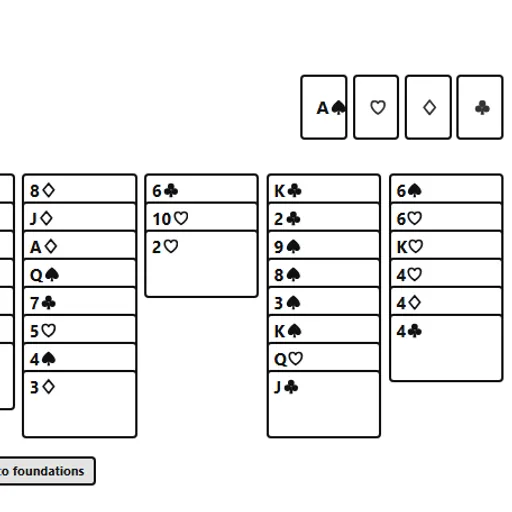
FreeCell Solitaire is a card puzzle where nothing is hidden. The full deck is laid out face up, so every problem is in plain sight from the first move. Your goal is to move all 52 cards onto four foundation piles, one per suit, starting with the Aces.
How FreeCell Solitaire Works
The deal spreads the cards over eight columns: four with seven cards and four with six. Inside the columns you build downward, placing a card on one rank higher of the opposite color, such as a black 6 on a red 7. Empty columns accept any card or a run that fits your move limit.
Above the columns sit four free cells. Each one holds a single card while you dig. They are your main helper, but every card you park there shrinks how many cards you can move at once.
Foundations grow from Ace up to King in one suit. Tap a card, then tap its foundation to send it home. A “Collect to foundations” button sends every card that is ready in one go, and one Undo puts the whole batch back.
Your First Few Minutes
- Scan the columns and spot where each Ace is buried.
- Pick the Ace closest to the bottom of a column and clear the cards over it.
- Move covering cards onto other columns before you use a free cell.
- Try to empty a full column, since it is worth more than a free cell.
- When most low cards are home, press Collect and finish the deal.
Controls for FreeCell Solitaire
| To do this | Keyboard | Mouse | Touch screen |
|---|---|---|---|
| Select a card, run or free-cell card | Tab to the card, then Enter or Space | Click the card | Tap the card |
| Move the selection | Tab to the target, then Enter | Click a column, an empty free cell or the matching foundation | Tap a column, an empty free cell or the matching foundation |
| Send every playable card home | not used | Click "Collect to foundations" | Tap "Collect to foundations" |
| Undo | not used | Click "Undo" | Tap "Undo" |
| Start a new deal | not used | Click "New game" (under "Menu" if hidden) | Tap "New game" (under "Menu" if hidden) |
What It Trains
FreeCell is planning in a small space. You often count three or four moves ahead to see whether a run will fit, and you hold track of which cells are still open. That is logic and steady focus at your own pace.
Strategy Notes
- Free the Aces and 2s first. Low cards blocked deep in a column hold up everything else.
- Treat free cells as borrowed. Fill one only when you know how it will empty again.
- Value empty columns highly. One open column doubles the size of the run you can move.
- Build clean runs. Alternating colors in order can later move as a single unit.
- Undo freely. Testing a line and stepping back costs nothing and teaches you the deal.
Good to Know
The cards scale to phones and tablets in either orientation, and you can play by mouse, touch or keyboard. There is no sound. It comes from Christopher Müller’s open-source PaperGames collection, and if you like quiet card logic, try Fox and Geese next.