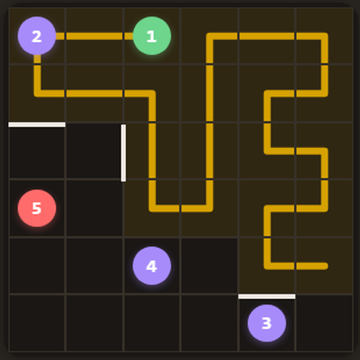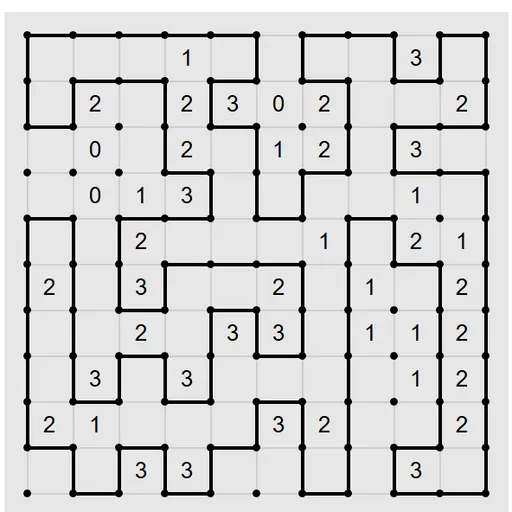
Loopy Loop Puzzle is a line-drawing logic game. You draw one closed loop along the edges of a grid, and numbers inside cells say how many of that cell’s sides the loop uses. The goal is a single ring that satisfies every number.
How Loopy Loop Puzzle Works
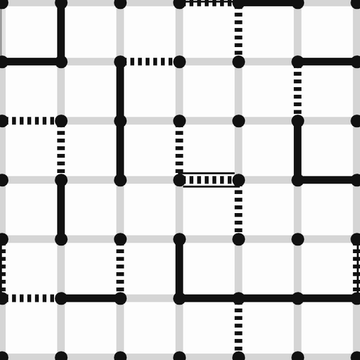
All possible lines start yellow, meaning undecided. Click one to make it black and part of the loop. Rule a line out if you know the loop skips it, and it fades. Clicking a line again sets it back to yellow.
The answer is one ring with no crossings, branches or breaks. At every dot on the ring exactly two loop lines meet, and dots off the ring have none. Each number must match its count of loop sides, while blank cells can have any count.
The Type menu offers square grids at Easy, Normal and Hard in two sizes, plus triangles, snub squares, Cairo pentagons, kites and Penrose tilings. A More submenu adds honeycombs, octagons, florets, hats, spectres and several dodecagon grids. Custom pairs any grid with Easy, Normal, Tricky or Hard.
Your First Few Minutes
- Start the default 10x10 Easy square grid.
- Rule out every side of each 0.
- Look for corner 3s and draw both outer edges.
- Check each dot, and extend lines that can only go one way.
- Keep growing the loop until it closes and the board flashes.
Controls for Loopy Loop Puzzle
| To do this | Keyboard | Mouse | Touch screen |
|---|---|---|---|
| Mark a line as part of the loop (click again to clear) | not used | Left-click the line | Tap the line |
| Rule a line out (click again to clear) | not used | Right-click the line | Press and hold the line |
| New game, undo, redo | N, U, R | Menu buttons above the grid | Menu buttons above the grid |
What It Trains
Loopy is a deduction puzzle. You combine cell counts with the rule that each dot has zero or two lines, and each step forces the next.
It also builds spatial reasoning, especially on odd tilings where cells have three, five or more sides and the usual patterns change.
Strategy Notes
- Zeros first. Rule out every side of a 0 before anything else.
- Pairs of 3s. On squares, two neighboring 3s use the line between them and both parallel outer lines.
- Corners help. A 3 in a square-grid corner uses both outer edges.
- Dot check. A dot with two black lines is full, and one with one black line and one open choice must continue there.
- No early rings. Closing a small loop is wrong unless it covers the whole answer.
- Learn new grids gently. Try a fresh tiling on an easier Custom setting first.
Good to Know
Undo, redo, restart and Solve are always available. Keyboard keys cover new game, undo and redo only. Mike Pinna wrote the puzzle for Simon Tatham’s Portable Puzzle Collection, and Lambros Lambrou added the unusual grids.