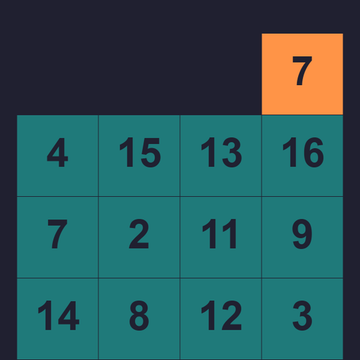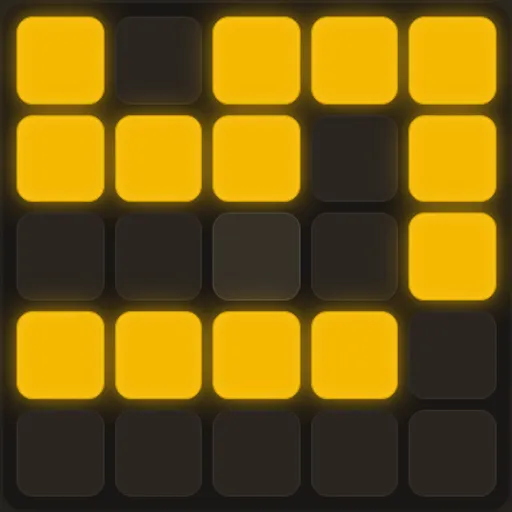
Light Switch Grid is a lights-off logic puzzle on a 5x5 board of amber cells. Pressing a cell flips it and the cells directly above, below, left and right of it. Your goal is to make the whole board dark, ideally in as few presses as possible.
How Light Switch Grid Works
Each press swaps the state of up to five cells. A lit cell goes dark and a dark cell lights up. Diagonals stay as they are, and edge or corner cells have fewer neighbors to flip.
A status line shows how many lights remain, and a counter adds up your presses. Clear the board and your total appears. Your lowest total per level is stored as Best, together with the level you last picked.
There are three levels. Easy, Medium and Hard differ in how many random presses scrambled the board. Each level begins on a daily board, and new rolls a random one. Undo takes back one press, and reset restores the start pattern of the same puzzle.
Your First Few Minutes
- Pick Easy and look at which cells are lit.
- Press one lit cell and watch which neighbors flip.
- Work row by row, pressing the cell under each light in the row above.
- When only the bottom row has lights, note the pattern.
- Use reset to restart and try a cleaner set of presses.
Controls for Light Switch Grid
| To do this | Keyboard | Mouse | Touch screen |
|---|---|---|---|
| Press a cell (flips it and its side neighbors) | not used | Click the cell | Tap the cell |
| Take back the last press | not used | Click "undo" | Tap "undo" |
| Return to the starting pattern | not used | Click "reset" | Tap "reset" |
| Pick a difficulty or roll a random puzzle | not used | Click Easy, Medium, Hard or "new" | Tap Easy, Medium, Hard or "new" |
| Open or close the help page | Esc or Q closes it | Click "? man", then the × or outside the box | Tap "? man", then the × or outside the box |
What It Trains
This puzzle is about logic and a bit of math. Because two presses on one cell cancel, each cell is either pressed or not. That turns the board into a yes-or-no question for each of 25 cells.
You also plan spatially. You picture the plus-shaped flip around a cell and predict which lights it will fix and which it will turn on.
Strategy Notes
- Chase down the rows. For every light in a row, press the cell right below it, then move to the next row.
- Use the bottom row as a clue. The pattern left at the bottom tells you which top-row cells to press before chasing again.
- One press per cell. A second press only cancels the first and adds a move.
- Sequence is free. Plan the set of cells to press, then press them in any order.
- Reset beats long undo chains. It returns the exact start board and zeroes the counter.
Good to Know
Best scores and your last level are saved in the browser. The large cells suit thumbs, and the board fits a phone held upright. The colors follow your device’s light or dark setting. Tejas Wavde made it as part of an open-source game collection.