Go is a centuries-old East Asian board game about claiming space. You and your opponent place black and white stones on the crossing points of a grid. Whoever controls more of the board when both players stop wins.
How Go Works
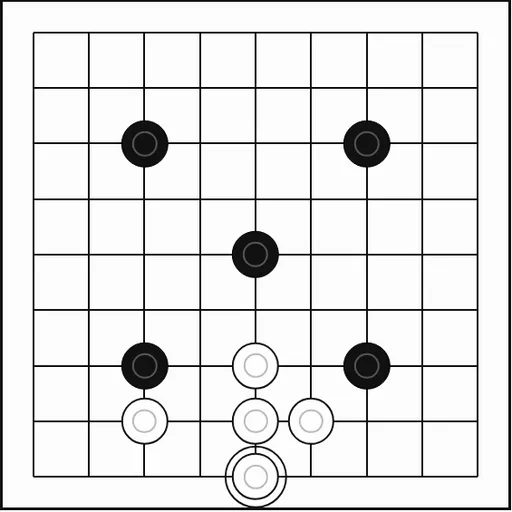
Black moves first, and then you take turns putting one stone on any empty point. A stone never moves once placed. Connected stones of one color form a group, and each group needs at least one open neighboring point, called a liberty.
Fill the last liberty of an enemy group and the whole group is captured and lifted off. A counter below the board tracks captures for both colors. Instead of placing a stone, you may pass. Two passes in a row end the game.
Scoring counts your stones on the board plus the empty points surrounded only by your color. White gets 7.5 bonus points, called komi, for moving second, so there are no ties. You can pick 9x9, 13x13 or 19x19, your color and a computer level, or play a friend on one screen.
Your First Few Minutes
- Choose the 9x9 board, black, and the Easy level.
- Place your first stones near the corners.
- Before attacking, count the liberties of both groups.
- Shape your groups so each has two separate empty points inside.
- Capture any hopeless enemy stones, then pass to finish.
Controls for Go
| To do this | Keyboard | Mouse | Touch screen |
|---|---|---|---|
| Place a stone | Tab to the board, arrow keys to pick an intersection, Enter to place | Click an empty intersection | Tap an empty intersection |
| Pass your turn | not used | Click "Pass" | Tap "Pass" |
| Choose board size, color and opponent | not used | Use the size menu, the black/white buttons and the level menu, then click "New game" | Use the size menu, the black/white buttons and the level menu, then tap "New game" |
| Take back a move | not used | Click "Undo" | Tap "Undo" |
| Give up the game | not used | Click "Resign" | Tap "Resign" |
What It Trains
Go asks you to read ahead: if you play here, they answer there, and who runs out of liberties first. You also judge areas of the board at a glance, which is a big-picture strategic and spatial skill.
Strategy Notes
- Take corners first. Board edges do half the walling for you, so corners are the cheapest space.
- Win liberty races. Never chase a group that has more liberties than your chasing stones.
- Build two eyes. A group with two separate empty points inside cannot be captured.
- Keep your eyes open. Filling your own eye can turn a safe group into a dead one.
- Clean up before passing. Dead stones count as they stand, so remove them first.
Good to Know
The board adapts to phones and big screens alike, and keyboard play is supported. There is no sound. Undo, Pass and Resign are always available, and the current game is saved in your browser. Go here is part of Christopher Müller’s open-source PaperGames collection.