Pocket Pool is a one-player billiards challenge on a six-pocket table. You break a rack of fifteen numbered balls and try to clear the felt using as few strokes as possible. With no opponent, your only rival is your own best count.
How Pocket Pool Works
Press Play and the cue ball sits on the head string with the triangle of balls at the far end. Aim, set your power and hit. The top bar shows strokes taken, your record and how many balls remain.
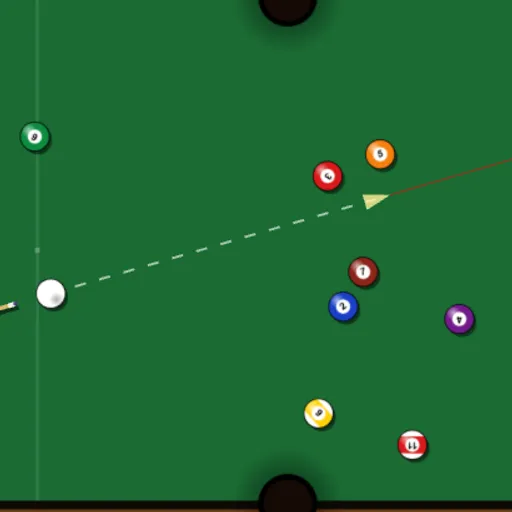
A dotted line and arrow show where the cue ball will go and how hard, and a percentage at the bottom gives the exact power. A red line extends straight beyond the arrow, but it never shows rebounds, so angles are up to you. Balls spin and bounce off cushions because the game uses the Box2D physics engine.
If the cue ball drops, that is a scratch. Wait for everything to stop, then set the cue ball down anywhere clear on the table. Pot the final ball to finish the rack.
Your First Few Minutes
- Press Play and aim straight at the front ball of the rack.
- Pull power near the top and break hard.
- Look for a ball close to a pocket and line up an easy pot.
- Use a light touch so the cue ball stays near the middle.
- Keep going until the table is empty, then press R for a new rack.
Controls for Pocket Pool
| To do this | Keyboard | Mouse | Touch screen |
|---|---|---|---|
| Aim and set power | not used | Point where the cue ball should go; farther from the ball means more power | Press and drag behind the cue ball; pull farther back for more power |
| Shoot | not used | Left click | Lift your finger |
| Fine-tune power | not used | Scroll the wheel (up adds power, down removes it) | not used |
| Fast-forward rolling balls | not used | Hold the right button | not used |
| Place the cue ball after a scratch | not used | Move to a spot and click | Drag to a spot and lift your finger |
| Start a new rack | R | Menu icon, then New Rack | Menu icon, then New Rack |
| Pause | Esc | Click the menu icon (top right) | Tap the menu icon (top right) |
What It Trains
Every stroke is a geometry problem. You picture the line from the cue ball to the object ball and from there to the pocket, then judge the angle where they meet.
Planning matters too. A good player thinks about where the cue ball will stop, so the next pot is already set up.
Strategy Notes
- Break with full power. A hard opening scatters the pack and may sink a ball or two for free.
- Tap balls in the jaws gently. A soft hit drops them without sending the cue ball in after.
- Think one ball ahead. Balls slow quickly once they crawl, so predict the cue ball’s resting spot.
- Make the most of ball in hand. After a scratch, set up the simplest straight shot on the table.
- Skip the waiting. Hold the right mouse button to fast-forward slow rolls.
Good to Know
Your lowest stroke count for a cleared table stays in the browser and shows on the title menu. Scroll the mouse wheel to fine-tune power. A rack takes a few minutes. Frank Force made it with the LittleJS engine.